Wasted Watts: Stranded Energy and Zombie Servers in Data Centers

This is Part 1 of a 3-part blog series around the looming climate challenge: the massive surge in data center energy consumption driven by AI. Written by the team at G2 Venture Partners.
There are 20 GW of power serving data centers in the U.S. today, and the rise of AI could double this number over the next 5 years. Data centers currently consume ~4% of U.S. electricity, but the DOE posits that this number will rise to 7–12% in just 3 years.¹
This surge presents a critical climate challenge, as the U.S. is not building clean energy infrastructure quickly enough to power this new demand. Experts therefore posit that, in the medium term, 75–100% of incremental data center power needs will be supplied by natural gas.²
It doesn’t have to play out this way.
At G2, we see a massive untapped opportunity to do more with less by addressing the waste already in the system.
- Utilize Stranded Energy: data centers can collocate with under-utilized energy sources
- Manage Compute More Efficiently: companies can optimize workloads and eliminate zombie servers to cut energy use by 30%+
These interventions would reduce the total data center capacity required for global IT infrastructure while also reducing the incremental power necessary for that capacity (while improving economics for renewable developers!).
Supply Side: The Opportunity in Utilizing Stranded Clean Energy
We are underutilizing existing clean power on the grid as curtailment (i.e., reducing generation to balance supply and demand, constrained by transmission or temporal demand trends) continues to grow.
The scale of waste is staggering:
- Texas (ERCOT) curtailed 5% of wind and 9% of utility-scale solar in 2022 — approximately 55 GW in total. By 2035, curtailments could reach 13% for wind and 19% for solar, doubling to 110 GW. 36% of this curtailment is expected to be geographic curtailment constrained by transmission, and 64% temporal.³
- Midwest (SPP & MISO) has seen a dramatic rise in wind curtailment. SPP’s hourly curtailment surged from 136 MW (2019) to 1,097 MW (2023), while MISO’s rose from 242 MW to 508 MW. In the Midwest, curtailments are more common due to transmission congestion rather than temporal demand trends.⁴
- California (CAISO) has experienced a sixfold increase in solar curtailment. In 2017, 379 GWh of solar and wind was curtailed, enough to power 59,000 homes for a year. By 2022, curtailment hit 2,400 GWh, equivalent to 382,000 households, exceeding the number of homes in San Francisco.⁵
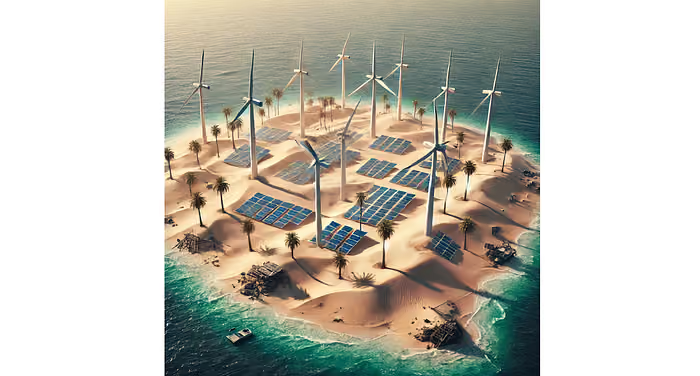
Curtailment is not just a U.S. issue — globally, thousands of GWh of renewable energy go to waste each year. Europe, for example, faces a growing curtailment challenge due to mismatches between offshore wind production and mainland demand.
While the data center industry increasingly turns to natural gas for new capacity, gigawatts of clean energy go to waste. The opportunity here is economic as well as sustainable. Curtailment reduces revenue for renewable energy developers, and tapping into curtailed energy can reduce power costs for data centers. Notably, wind and solar PPA prices are already lower than fossil fuels.
There is a clear opportunity to collocate new data centers in regions with high renewable curtailment.
Demand Side: The Opportunity in Enhancing Compute Efficiency
Today’s public conversation, centered on adding new power capacity, overlooks a massive efficiency opportunity within existing data center infrastructure. The reality is that existing data centers are not fully utilized today:
- First, a significant portion of servers sit idle: 30% of all virtual servers and 25% of all physical servers are in an idle state (“zombies”, if you will!), having done no work for at least 6 months.⁶

2. Second, even active servers are underutilized: ABB reports that servers typically operate at just 5–15% utilization.⁷ Further, Datadog finds that 65–70% of Kubernetes workloads in data centers use less than half of their allocated CPU and memory,⁸ tying up compute resources that could be redeployed to other applications.
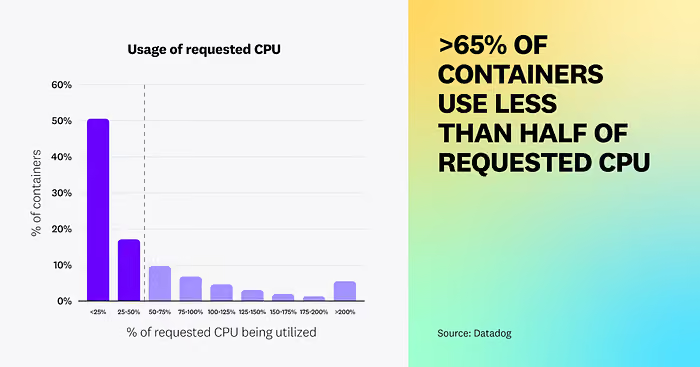
These inefficiencies are caused by overprovisioning (requesting more resources than needed to ensure uptime), shifting workloads (workloads change in what they need over time), and manual provisioning (delays between identified optimization opportunities and ultimate implementation) leading to idle compute cycles. DevOps teams aim for efficiency, but with limited bandwidth and a focus on reliability, optimization often takes a backseat.
And, this inefficiency has direct energy implications. A typical server consumes 30–40% of its maximum power even when idle⁹ — those “comatose” servers are still consuming power! Additionally, under-utilized servers are inefficient — research has consistently shown that improving server utilization can lead to substantial energy savings¹⁰,¹¹,¹²,¹³
To bring it all together, McKinsey estimates that optimizing cloud migration and workload allocation alone could reduce data center emissions by 55%, or 40 MT of CO2e annually (the equivalent of the total carbon emissions of Switzerland!)¹⁴.
The Path Forward: Do More with Less
At G2, we aim to do more with less. The most economic and sustainable path forward is to fully utilize what we’ve already built. By collocating data centers with stranded renewable energy and optimizing compute in existing data centers, we can mitigate the industry’s impact on climate, lower energy costs, and create a more sustainable future.
— —
ABOUT G2 VENTURE PARTNERS
G2 Venture Partners invests in technology companies at their inflection points to build a sustainable future. The firm focuses on innovation in the transportation, energy, industrials, agriculture, logistics, and retail sectors, with investment stages ranging from venture to growth. We look for companies poised for explosive growth, with proven product-market fit and commercial traction. Our portfolio includes Crusoe Energy, Luminar (NASDAQ: LAZR), Arcadia, 1Komma5°, and Pivot Bio.
Sources:
² TD Cowen, Data Centers, Generative AI & Power Constraints: The Path Forward, May 2024.
³ https://www.eia.gov/todayinenergy/detail.php?id=57100
⁴ https://www.eia.gov/todayinenergy/detail.php?id=62406
⁵ https://ecoblock.berkeley.edu/blog/californias-growing-solar-and-wind-problem/
⁶ https://www.computerworld.com/article/1680190/a-third-of-virtual-servers-are-zombies-2.html
⁷ https://new.abb.com/news/detail/66580/how-data-centers-can-minimize-their-energy-use
⁸ https://www.datadoghq.com/container-report/
⁹ https://new.abb.com/news/detail/66580/how-data-centers-can-minimize-their-energy-use
¹⁰ https://onlinelibrary.wiley.com/doi/10.1155/2022/8734198
¹¹ https://journalofcloudcomputing.springeropen.com/articles/10.1186/s13677-022-00368-5
¹² https://journalofcloudcomputing.springeropen.com/articles/10.1186/s13677-022-00368-5
Norem ipsum dolor sit amet, consec tetur adipis cing elit. Nunc vulputate libero et velit interdum.