Decarbonization is not on autopilot: Why efficiency matters more than ever in 2026

.avif)
At G2, we invest in what we call the two pillars of climate tech: decarbonization (using decarbonized forms of energy and materials) and efficiency (using less energy and materials). However, there is a common question we get when we discuss the carbon impact of our efficiency investments: “If the grid is going to be carbon-free in [name your timeframe] years anyway, does it really matter how much energy this product saves?” Our view has always been that yes, it does, and 2025 made this answer clear.
Decarbonization is not on autopilot, and efficiency is one of the most important levers we have to keep it on track. So, we thought it would be useful to lay out how we think about the impact of efficiency at three levels:
- Our methodology for calculating the carbon impact of efficiency investments
- What 2025’s data tells us about the state of grid decarbonization
- Why efficiency is more critical today than ever
How We Calculate the Carbon Impact of Efficiency Investments
When we make an efficiency investment — whether it is optimizing the HVAC system in a commercial building, reducing energy waste in an industrial facility, or improving the performance of a data center — we calculate the avoided carbon emissions by multiplying the energy saved (in kWh) by the carbon intensity (CI) of the grid. Simple, in theory! The hard question: which carbon intensity do you use?
This matters a lot. If you assume the grid will be nearly carbon-free by 2035, then the carbon impact of saving a kWh of electricity in year 10 of an investment looks quite small. Some analysts use exactly these kinds of aggressive grid decarbonization forecasts as their baseline — and if they do, efficiency investments look far less impactful than they actually are.
We think this approach misses something important. Here is how we think about it instead.
We track the carbon impact of efficiency investments across a range of grid CI scenarios, acknowledging genuine uncertainty about both which baseline is appropriate and how fast the grid will decarbonize.
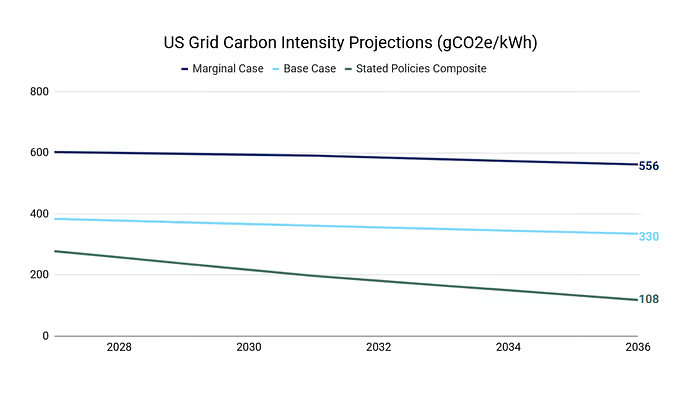
‘Marginal’ Carbon Intensity (Dark Blue Line): When an efficiency solution saves a kilowatt-hour, the grid doesn’t reduce output from every source proportionally. It ramps down the last plant dispatched, which, in the US, is almost always a gas or coal peaker, not a wind farm. This is referred to as the ‘marginal’ supply. The marginal carbon intensity rate is roughly 1.5x the grid average: 591 gCO2/kWh nationally (PNAS), with the EPA’s ‘nonbaseload’ (i.e., marginal) estimate even higher at 637. And here’s the counterintuitive part: over 2010–2019, the average carbon intensity of the full grid fell 28%, but the carbon intensity of the marginal supply actually increased 7%! Why? As coal shifted from running all the time to running only when needed, it became a larger share of the marginal mix. We project the marginal carbon intensity to decline slowly from here: 0.5%/yr through 2030, 1.0%/yr through 2035, and 1.5%/yr thereafter, reflecting the gradual exit of coal from the dispatch stack and the slow turnover of gas peaker fleets.
Base Forecast (Light Blue Line): We use the current US average grid carbon intensity of ~384 gCO2e/kWh (Our World in Data) and apply a -1.5%/yr annual decline, consistent with the observed rate over the last 10 years. By using the full grid average CI rather than the marginal, we are conservatively understating the emissions benefit of an efficiency solution.
Faster Decarbonization Scenario (“Stated Policies”): These faster scenarios are generally built around commitments made by different entities (countries, companies, etc.) and therefore embed significant efficiency gains and clean capacity build-out into their assumptions. We use this as a sensitivity case, not as a base assumption, as the impact of our investments (and other companies like them) is already at least partially assumed in these cases.
The result is a range of estimated impact potential, and we believe it’s the most intellectually honest approach. Our efficiency investments look impactful across all of the scenarios, but particularly so in the base and marginal cases.
The 2025 Wake-Up Call: We Are Behind Pace
Unfortunately, 2025 provided a vivid reminder of why we don’t rely solely on the most optimistic decarbonization trajectory in our analysis.
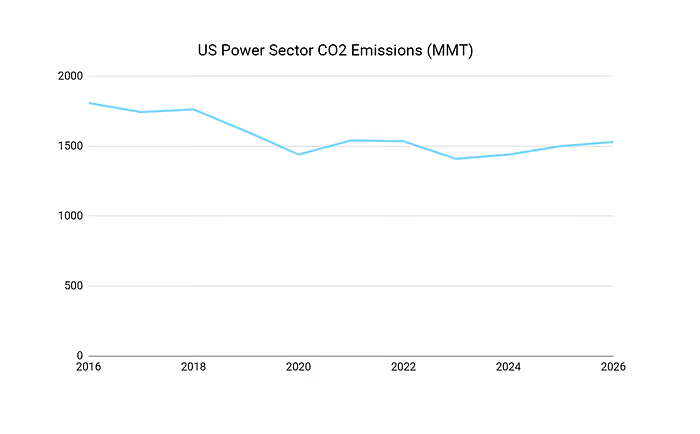
After two consecutive years of declining US greenhouse gas emissions, 2025 saw economy-wide emissions increase by 2.4%, according to Rhodium Group’s preliminary analysis. That is the third-largest annual increase in the past decade, and it ended what many hoped was a durable downward trend.
The power sector was a significant part of the story. Power sector emissions rose by 3.8% in 2025, driven by two forces: a cold winter that pushed up heating demand, and, more structurally important, surging data center activity that drove commercial electricity demand up by 2.4%. This demand growth was met largely by ramping up fossil generation. Coal generation, which had been on a long secular decline, actually increased in 2025.
The scale of data center growth is difficult to overstate. According to 451 Research / S&P Global, utility power delivered to hyperscale and leased data centers was expected to reach 61.8 GW by the end of 2025, a 22% increase in a single year. By 2030, that figure could reach 134 GW, nearly triple 2024 levels. For context, that’s roughly equivalent to the entire US coal fleet today.
What does this mean for grid carbon intensity? In 2024, the US average grid CI fell to a record low of 384 gCO2/kWh (Ember), continuing a long decline from 598 gCO2/kWh in 2007. But 2025’s data suggests that this trend is not guaranteed to continue smoothly. The EIA projects that higher demand will be met primarily by increased utilization of gas-fired plants — and, in some regions, by slowing coal retirements. Rhodium now projects that the US is on pace to cut emissions by only 26–35% by 2035, compared to prior estimates of 38–56%. That’s a meaningful downward revision, and it doesn’t yet fully reflect the policy environment under the current administration.
Perhaps most strikingly, in 2025, US emissions grew faster than real GDP, snapping a three-year streak where the two had been decoupling. The foundational assumption of the energy transition is that you can grow the economy while shrinking emissions. In 2025, that assumption did not hold.
Why This Makes Efficiency More Important Than Ever
Grid decarbonization and energy efficiency are complements, not substitutes. The assumption that a clean grid will arrive on schedule — and therefore that efficiency doesn’t matter much — gets the causality backwards.
Consider what is actually happening. The US added a record amount of solar generation in 2025 — a 34% increase in solar output year-over-year (Rhodium), meeting 61% of electricity demand growth (Ember). That’s remarkable. But data center and AI demand growth is outpacing this supply growth. The EIA notes that between 2020 and 2025, US electricity demand grew at 1.7% annually, compared to just 0.1% per year between 2005 and 2019. This surge is pushing utilities to build more gas-fired capacity, extend the lives of coal plants, and delay retirements — effectively slowing down the decarbonization of the grid.
Efficiency directly addresses this. Every kilowatt-hour saved reduces the total demand the grid has to serve, and that matters in two ways. In the near term, it means less fossil generation dispatched today to serve peak loads. In the longer term, it changes the investment calculus for utilities and grid operators: less demand means less pressure to build new fossil capacity, or extend the life of existing plants, as a bridge to a clean grid.
This is why we push back on the idea that efficiency investments are low-impact in a “near-term clean grid” scenario. That clean grid is not free. It requires a massive build-out of renewables and storage capacity, while simultaneously managing a surge in electricity demand. Efficiency reduces the size of that challenge. In the absence of efficiency gains, the pace of clean generation build-out required to hit decarbonization targets becomes even more daunting — and, as 2025 showed, the grid is already struggling to keep up.
We will continue to track our carbon impact across a range of scenarios, because intellectual honesty requires acknowledging uncertainty. But if anything, 2025 makes us more confident, not less, that efficiency investments are essential to climate tech. They reduce emissions today, while buying the time and headroom the grid needs to finish the job.
Norem ipsum dolor sit amet, consec tetur adipis cing elit. Nunc vulputate libero et velit interdum.