
.avif)
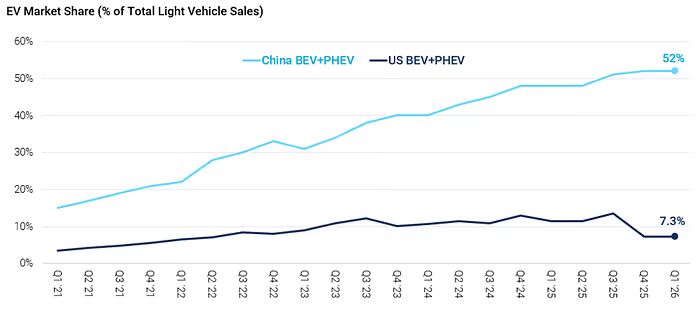
The numbers are rough. U.S. new EV sales dropped 27% year-over-year in Q1 2026, the first full quarter since federal purchase credits expired¹. Early adopters who were willing to pay a premium for EVs have mostly bought in. The mass market in the US, more generally focused on price (and still to some degree range anxiety), is still on the sidelines. Interestingly, the picture is very different in China, where plug-in vehicles have now crossed over 50% market share to become a majority of light-duty vehicle sales.
Some have called this the end of the EV era — but that’s a naive, short-term view.
Writing off EVs now would be a costly mistake for investors and automakers. The early boost from subsidies and hype is giving way to deeper, more durable demand drivers.
The next surge in EV demand will be driven by the convergence of four forces:
- Economics of self-driving fleets
- Strategic positioning of OEMs
- Buildout of charging infrastructure,
- Fossil fuel price volatility that makes the predictability of electric powertrains increasingly valuable across every segment of transportation.
These forces are already in motion.
Robotaxis Are the Spark
Every meaningful Autonomous Vehicle (AV) platform operating at commercial scale today is all-electric. Waymo’s 3,000-vehicle fleet runs on Jaguar I-PACEs. Uber’s new premium robotaxi service launching in San Francisco is built on Lucid Gravity SUVs. Zoox’s purpose-built is electric. None of this is ideological. It’s just what works best, based on engineering and economics.
The utilization profile of an autonomous commercial fleet (high daily mileage, centralized depot charging, predictable routes) maps almost perfectly onto the strengths of an electric drivetrain: low cost per mile, minimal moving parts, and charge cycles that can be optimized around off-peak energy rates.
The scale of the buildout is accelerating. Waymo served over 14 million trips in 2025, more than triple the prior year, and is now on a path to 1 million rides per week by end of 2026 across 26 markets, including London and Tokyo. Uber has stated its intention to be the world’s largest facilitator of AV trips by 2029, targeting autonomous service in 15 cities by year-end. These are commercial operations facilitating a pace of electric transport adoption that dwarfs the consumer market during the subsidy era. By 2035, we forecast that Waymo alone will account for ~40B annual miles traveled, nearly 80% of all passenger EV miles traveled in 2025² ³.
The robotaxi wave is just the ignition.
Personally Owned AVs Are Next
Robotaxis are just the first step. Personally owned autonomous vehicles will be where the real shift happens. When full autonomy reaches everyday cars, buyers will be choosing between an autonomous EV and a traditional gas car — a much different, and more compelling, comparison.
Consumers who would never pay extra for a plug-in will gladly pay a significant premium for a car that drives itself.. And the most capable autonomous systems are being built, tested, and deployed on electric platforms. Tesla’s FSD has accumulated over 6 billion miles (with 1.1M active FSD subscribers as of Q1 ‘26). Waymo’s sixth-generation driver launched in 2026 with fully driverless commercial operations. Waabi, in which we co-led the Series C alongside Khosla Ventures, is deploying L4 autonomy in both long-haul trucking and robotaxi — with Uber investing $500M and committing to purchase and deploy 25,000 Waabi-enabled vehicles, one of the largest AV fleet commitments announced to date. The investment in autonomy is overwhelmingly flowing into electric platforms, and that embedded infrastructure advantage will compound over time.
When personal autonomy scales, it will bring EV adoption with it, regardless of whether the consumer cares about the powertrain.
OEMs Who Stayed in the Game Will Be Rewarded
The softening of consumer EV demand has prompted some OEMs to pause or scale back their electric programs (looking at you Ford!). That may prove to be one of the more expensive strategic errors of the decade.
The OEMs who remain committed to EVs are positioning themselves as the natural partners for the AV platforms now building at scale. Volvo is already integrated with Waabi for autonomous trucking. Jaguar became Waymo’s initial platform of choice for its commercial fleet. Lucid is the vehicle behind Uber and Nuro’s next-generation robotaxi. And Hyundai, which had the conviction to open a major new EV manufacturing facility in Georgia, was rewarded with a landmark multi-year partnership with Waymo, with negotiations underway to supply up to 50,000 IONIQ 5 robotaxis by 2028, a deal potentially worth $2.5 billion. The IONIQ 5s will roll off Hyundai’s Metaplant America line EV-ready, then be upfitted with AV sensors before entering commercial service.
These partnerships are the result of years of engineering work between AV developers and OEMs that can actually deliver reliable, high-utilization electric vehicles at volume.
The manufacturers who retain EV capabilities, continue investing in the platform, and build relationships with AV developers will find themselves with privileged access to what could be the highest-utilization vehicle fleet in history. Those who retreat will be watching from the sidelines.
Charging Infrastructure Gets Its Anchor Tenant
One of the structural challenges of building out EV charging infrastructure has always been demand predictability. Consumer charging is diffuse, irregular, and hard to finance. That calculus changes materially with commercial AV fleets.
A fleet of 1,000 robotaxis operating in a single city requires dedicated, high-power depot charging with predictable, high-throughput overnight demand. That is the kind of contracted, bankable load that infrastructure investors can actually underwrite. Multiply it across 20 cities and the business case for large-scale charging networks becomes far more durable than the consumer build-out ever was.
Uber is already acting on this, committing $100 million to build roughly 1,000 high-power DC fast-charging points across the U.S. and Europe — backbone infrastructure for a commercial AV fleet, not a consumer convenience amenity. And despite a difficult policy environment, U.S. public fast-charging grew 30% year-over-year in 2025. The commercial logic is proving stronger than the political tailwind ever was. And with more EV charging infrastructure, the flywheel of broad EV adoption will accelerate.
The Commercial Vehicle Wildcard
Perhaps the most underappreciated dimension of this story is what happens to commercial transportation. Long-haul trucking, medium-duty delivery, and transit buses share a common profile: high annual mileage, centralized fleet management, and sensitivity to fuel cost volatility. These are exactly the conditions under which electric drivetrains, particularly when combined with autonomy, deliver the most compelling economics. They also have persistent driver shortages, further compounding the advantages of AVs.
The structural case for electrifying commercial vehicles was already strong before the current geopolitical environment. Fuel cost volatility driven by ongoing instability in oil markets has made it more urgent. For fleet operators running thin margins on cost-per-mile, the unpredictability of diesel is itself a risk to be managed, and a fixed, predictable electricity cost serves as a great financial hedge.
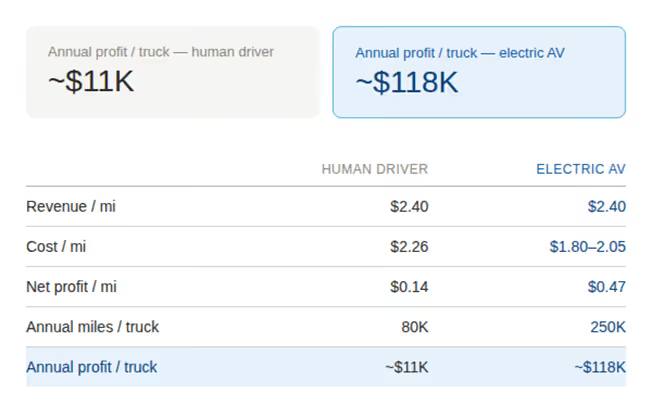
Autonomous commercial vehicles amplify this further. Waabi and others are demonstrating that L4 autonomous trucking is not a distant prospect — it is being tested and deployed on public roads today. An autonomous electric truck running 250,000 miles per year (versus ~80,000 for a human-driven truck) changes carrier economics so dramatically that the transition becomes a competitive imperative.
Illustrative Carrier Economics
The first decade of EV adoption ran on subsidies and early-adopter enthusiasm. That era is over. What comes next is driven by a different kind of buyer: autonomous fleet operators who need electric vehicles because of physics and unit economics. The charging infrastructure gets built because those fleets are bankable customers. The OEMs who kept their EV programs running get rewarded with the highest-utilization vehicle contracts in history. And consumer adoption follows, because the best self-driving car you can buy happens to be electric.
The demand isn’t gone. It’s just coming from a direction nobody was watching.
Sources:
¹Cox Automotive, Q1 2026 EV Sales Report, https://www.coxautoinc.com/insights/q1-2026-ev-sales-report-commentary/
² Edmunds, How many Electric Cares Are There in the U.S., https://www.edmunds.com/electric-car/articles/how-many-electric-cars-in-us.html
³ Green Car Reports, US EV Mileage, https://www.greencarreports.com/news/1143527_us-evs-driven-less-than-ice-vs-world
Norem ipsum dolor sit amet, consec tetur adipis cing elit. Nunc vulputate libero et velit interdum.